Vaishno Devi: significance and a practical pilgrimage guide
Plan your visit to the holy cave in the Trikuta hills: spiritual tradition, reaching Katra, registration, darshan and accommodation.
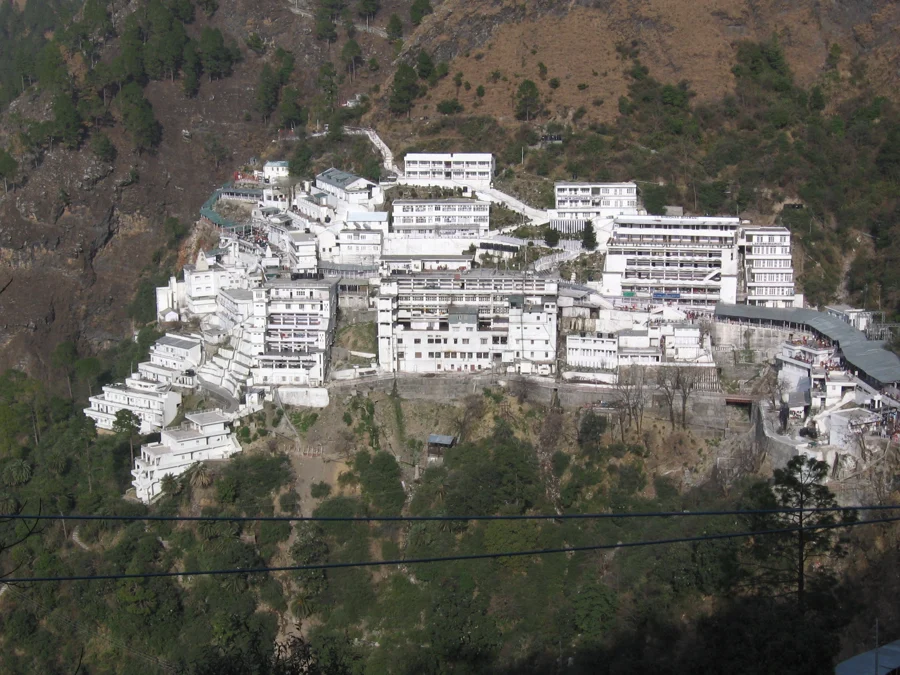
Photo: Abhishek Chandra · Wikimedia Commons · Public domain (PD-self) · Resized; converted to WebP.
Location and spiritual significance
The shrine is in the Trikuta hills in Reasi district, Jammu and Kashmir, with Katra as the pilgrimage base. At Bhawan, three natural rock formations, the Holy Pindies, are worshipped as Maha Kali, Maha Lakshmi and Maha Saraswati. Devotees visit for prayer and reflection. Belief in the fulfilment of wishes belongs to religious tradition and is not a guarantee of a particular outcome.
The traditional story
The tradition describes devotee Pandit Sridhar of Hansali, a community meal blessed by the Goddess, and the events involving Bhairon Nath. Many pilgrims visit Bhairon Temple after the main shrine, following the blessing described in this narrative. Read this as a sacred traditional account rather than a claim that every detail has been established by historical evidence.
Arriving by train
Search for Shri Mata Vaishno Devi Katra railway station, code SVDK. If your city has no convenient direct service, plan a connection through Jammu Tawi and continue to Katra. Check actual train days, seat availability and arrival times with IRCTC. On arrival, leave excess baggage at your accommodation and complete registration. The railway brings you to the base town; it does not take you to the cave.
Arriving by air or road
Jammu Airport is a practical gateway, followed by a road transfer to Katra. Allow approximately 50–65 km from Jammu, depending on your departure point and route. About two hours is a planning allowance, not a fixed journey time; traffic and security checks can add delays. Use authorised transport, agree the fare before departure and leave a generous buffer before a return flight or train.
Registration and RFID, step by step
Register for your intended date through the official Shrine Board portal, or use an authorised registration counter. Save the online booking slip. Before starting the trek, show it at an authorised counter and collect the RFID Yatra Access Card: online registration alone does not replace collection of the card. Carry identification and service booking documents, complete registration for each traveller, and follow checkpoint instructions.
Walking from Katra to Bhawan
Plan for roughly 13 km uphill one way, with the return journey in addition. The traditional route includes Banganga, Charan Paduka and Adhkuwari. Beyond Adhkuwari, the selected route may take you via Himkoti or Sanjichhat. Tarakote is an alternative approach; follow official signs for entrances and connections. Do not assume every landmark belongs to one straight route. Pace, queues and rest stops determine the time needed.
Helicopter, battery car and assistance
Katra–Sanjichhat helicopter services depend on availability and weather. An onward journey to Bhawan remains after landing; the helicopter does not land at the cave entrance. Battery cars cover a designated Adhkuwari–Bhawan section rather than the entire Katra trek. For ponies, palanquins or porters, check authorised registration, approved rates and route restrictions. Transport bookings do not automatically include a separately booked darshan service. Read the current cancellation and refund terms.
Darshan, Adhkuwari and Bhairon
Follow security checks and the managed queue at Bhawan for darshan of the Pindies. Access to the old natural cave is governed by current arrangements and cannot be assumed. Garbh Joon at Adhkuwari may involve a separate queue. Bhairon Temple is a further visit; the Bhawan–Bhairon Ghati ropeway, when operating, serves that section, not Katra–Bhawan. Aarti and special services have their own booking rules.
Accommodation, meals and budget
Shrine Board rooms and dormitories are offered at Jammu, Katra, Adhkuwari, Sanjichhat and Bhawan, subject to availability. Use the official portal and check the exact location before reserving. For private Katra hotels, compare walking distance and cancellation terms. Budget separately for intercity travel, lodging, meals, local transfers and optional services. Check current catering and langar arrangements. This guide does not quote a fixed package price because tariffs and availability change.
Weather and packing
Check current weather and route notices, especially during rain or winter conditions. Festival periods and holidays can bring heavier queues. Carry suitable walking shoes, light warm layers, rain protection, water, identification and your regular medicines. Leave unnecessary heavy bags at Katra. Use authorised rest areas and avoid landslide-prone stretches. If the route is officially closed, postpone rather than attempting another unapproved path.
A suggested three-day plan
Day 1: arrive in Katra, check in, complete registration/RFID collection and rest. Day 2: begin at a pace appropriate for your group, visit Bhawan, and include Bhairon only if time, weather and fitness permit; return or use prebooked accommodation. Day 3: rest before your onward journey. This is an illustrative plan, not a requirement to finish the pilgrimage in one day. Allow more time with children or older travellers.
Official help and final checks
Before leaving, check track status, weather, booking confirmations and refund conditions. Shrine Board assistance: 18001807212 or 01991-234804; WhatsApp 9906019494. Book directly through official channels and never share account passwords or OTPs with strangers. Choose the climb according to your health and seek medical advice before travel when needed.
Rail options from five cities
These are examples from published railway routes, not live schedules or seat availability. On IRCTC confirm your date, direction, boarding station, scheduled stop and seat. Check timings, cancellations and diversions on NTES. Connections require separate bookings and a generous transfer margin; they are not guaranteed.
Train routes and connections — expand to read
| City / boarding station | Train number and name | Alight at | Route |
|---|---|---|---|
| Mumbai Bandra Terminus (BDTS) | 12471 — Swaraj Express | Shri Mata Vaishno Devi Katra (SVDK) | Direct train |
| Delhi New Delhi (NDLS) | 12445 — Uttar Sampark Kranti Express | Shri Mata Vaishno Devi Katra (SVDK) | Direct train |
| Bengaluru KSR Bengaluru (SBC) | 22691 — Rajdhani Express 12445 — Uttar Sampark Kranti Express | Shri Mata Vaishno Devi Katra (SVDK) | Change trains · Delhi: NZM → NDLS |
| Chennai MGR Chennai Central (MAS) | 16031 — Andaman Express | Shri Mata Vaishno Devi Katra (SVDK) | Direct train |
| Hyderabad Hyderabad Deccan (HYB) | 12721 — Dakshin Express 12445 — Uttar Sampark Kranti Express | Shri Mata Vaishno Devi Katra (SVDK) | Change trains · Delhi: NZM → NDLS |
SVDK → Katra lodging/registration → Bhawan on foot or permitted services.
In Delhi, transfer from NZM to NDLS as well as changing trains; allow time for the city transfer.
Official sources and booking
- Indian Railways — station names and codes
- Shrine Board — overview and tradition
- Shrine Board — Holy Pindies
- Reasi district — location and access
- Shrine Board — reaching Katra
- Shrine Board — registration and official bookings
- Shrine Board — travel services
- Shrine Board — accommodation
- Shrine Board — pilgrim instructions
- IRCTC — train booking
- Indian Railways — Trains at a Glance 2026, table 7 (Samalkot)
- Indian Railways — TAG 2026, table 9 (Delhi–Raichur)
- Indian Railways — TAG 2026, table 10 (Mumbai/Chennai–Raichur)
- Indian Railways — TAG 2026, table 16 (Jammu/Katra)
- Indian Railways — TAG 2026, table 71 (Rayalaseema)
- Indian Railways — official train name and number list
- IRCTC — date-specific bookings and stops
- NTES — schedules and running information