Amarnath: significance, routes and pilgrimage preparation
The sacred ice lingam, the Pahalgam and Baltal approaches, registration, health certification and preparation for a high-altitude pilgrimage.
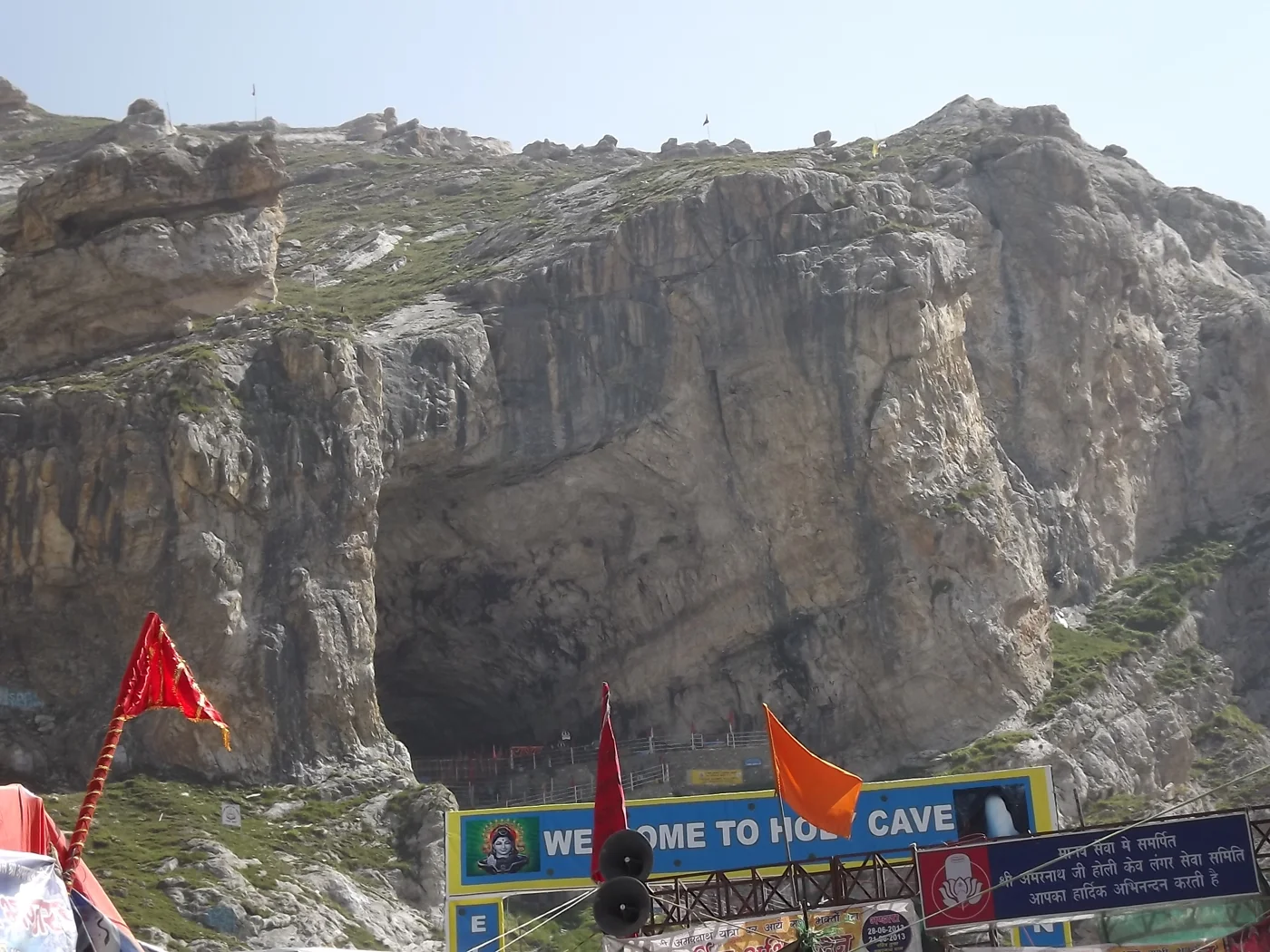
Photo: Guptaele · Wikimedia Commons · CC BY-SA 4.0 · Resized; converted to WebP.
Location and significance
The sacred cave is in the Kashmir Himalayas. Devotees worship the naturally forming ice lingam as a manifestation of Shiva, often calling it Baba Barfani. The pilgrimage has a place in prayer, devotion and reflection. Ice formation changes with natural conditions; a particular size or duration of visibility cannot be promised. Religious beliefs about blessings are presented as tradition, not guarantees of a specific result.
The Shiva–Parvati tradition
The traditional narrative describes Shiva sharing the secret of immortality with Parvati in this secluded cave. Landmarks along the approach are associated with leaving behind Nandi, the moon, serpents and the elements. Read this as sacred tradition rather than an assertion that each detail is independently established history. Separating spiritual narrative, mountain geography and present travel arrangements helps visitors understand the pilgrimage.
Season and current planning
This is a seasonal organised pilgrimage, not a year-round walk-in visit. SASB announces the permitted dates, registration and access arrangements for each summer season. Sources were checked on 2 October 2026; this guide does not certify that the route is open today. Wait for the relevant season’s official notice before making non-refundable bookings. Do not reuse a previous year’s dates, forms or booking links as if they applied to the next season.
Reaching the base camps
Srinagar Airport is a useful gateway, followed by road travel to Nunwan near Pahalgam or Baltal near Sonamarg. Rail travellers should check current services to their chosen Jammu/Kashmir station and arrange onward road transport; no railway goes to the cave. Check any authorised seasonal transport from the Jammu pilgrimage camp. Allow time for traffic, weather and security checks rather than planning a tight flight-to-trek connection.
Pahalgam route: stages and distance
The traditional sequence is Pahalgam/Nunwan → Chandanwari → Pissu Top → Sheshnag → Mahagunas Pass → Panjtarni → Holy Cave. Nunwan is roughly 90 km by road from Srinagar. The walking distance from Chandanwari to the cave is approximately 32 km, with the Pahalgam–Chandanwari transfer in addition. Distances depend on the starting point: do not confuse that trek with the entire trip from Pahalgam. Plan for stages, climbs, passes and camp stays.
Baltal route: shorter does not mean easier
The approach runs from Baltal through Domel and the Barari Marg/Sangam area to the cave. Baltal is approximately 95 km by road from Srinagar, near Sonamarg. The trek is about 14 km one way, plus the return. Steep climbing and descending can make the shorter route demanding. Do not promise your group a same-day return; follow access timings, individual fitness and current instructions.
Choosing a route
Pahalgam generally requires more days and camp logistics. Baltal is shorter but its gradients and return can be strenuous. Decide using health, the least capable member of the group, permitted dates and available time. Make sure the route on the permit matches the plan. Do not assume that switching routes or returning by another approach is automatically authorised or that transport will be available.
Registration, permits and RFID
Read the current season’s SASB instructions first. Use the announced online registration option or designated bank branch for a chosen route and date. Prepare identification, contact details, the required CHC and the fee. The permit date is the authorised date for crossing the Domel or Chandanwari access gate. Collect the RFID card at an authorised centre after verification and wear it during the pilgrimage. A payment receipt does not replace all access formalities.
Health certificate and eligibility
Under the 2026 guidelines, a Compulsory Health Certificate must use the prescribed format and come from an authorised doctor or institution. An ordinary fitness note is not a substitute. People under 13 or over 70, and women more than six weeks pregnant, are not eligible for registration even with a CHC. Recheck the age rules, authorised doctor list and certificate issue-date window for the season you intend to travel. Your clinician should assess personal fitness.
Altitude and weather precautions
The cave is at around 12,800 feet, with higher sections on the route. Low oxygen, cold and sustained climbing make this different from a city walk. Ascend slowly, rest and stay with your group. If headache, nausea, dizziness, unusual breathlessness or sickness develops, stop ascending and seek the nearest medical team; follow their advice about moving to a lower altitude. The Board advises avoiding an overnight stay at the cave. Do not treat determination or a transport booking as protection against altitude illness.
Helicopters and assisted travel
Older information lists Pahalgam/Neelgrath–Panjtarni helicopter sectors, but their operation must not be assumed for your season. The official site carries a 2026 No Flying Zone notice for the yatra routes. Confirm current permission, services and booking directly with SASB. Even when an approved service runs, onward travel from Panjtarni remains; it does not bypass medical or registration rules. Verify registration and approved rates for ponies, palanquins and porters.
Accommodation, food and budget
Seasonal tent accommodation may be available at authorised camps such as Nunwan, Baltal, Sheshnag and Panjtarni. Check bedding, storage and current rates; a mountain tent is not equivalent to a hotel room. Authorised langars provide meals, but confirm arrangements along your route and timing. Budget separately for intercity travel, transfers, rooms/tents, registration and optional assistance. Allow funds for weather delays. An old tariff page should not be treated as a current-season price list.
Packing and an adaptable plan
Carry identification, permit, CHC, RFID, grippy walking shoes, layered warm clothes, rain protection, a water bottle and regular medicines. Keep documents and clothes waterproof. Plan medical assessment and travel first, then the official date/route, camp rest and acclimatisation time, followed by permitted trek stages. Keep a spare day before your onward return. This is a planning framework, not a guaranteed itinerary; do not rely on packages promising completion within fixed hours.
Help and final checks
Official assistance: 14464, 1800-180-7198 and 1800-180-7199. Before departure, verify route opening, permit date, camp arrangements and transport. Do not use closed paths, shortcuts or travel outside authorised hours. Tell security staff or camp officials immediately if a group member is missing. Keep the area clean and do not throw objects near the ice lingam. Official reference links are provided below.
Rail options from five cities
These are examples from published railway routes, not live schedules or seat availability. On IRCTC confirm your date, direction, boarding station, scheduled stop and seat. Check timings, cancellations and diversions on NTES. Connections require separate bookings and a generous transfer margin; they are not guaranteed.
Train routes and connections — expand to read
| City / boarding station | Train number and name | Alight at | Route |
|---|---|---|---|
| Mumbai Bandra Terminus (BDTS) | 12471 — Swaraj Express | Jammu Tawi (JAT) | Direct train |
| Delhi New Delhi (NDLS) | 12445 — Uttar Sampark Kranti Express | Jammu Tawi (JAT) | Direct train |
| Bengaluru KSR Bengaluru (SBC) | 22691 — Rajdhani Express 12445 — Uttar Sampark Kranti Express | Jammu Tawi (JAT) | Change trains · Delhi: NZM → NDLS |
| Chennai MGR Chennai Central (MAS) | 16031 — Andaman Express | Jammu Tawi (JAT) | Direct train |
| Hyderabad Hyderabad Deccan (HYB) | 12721 — Dakshin Express 12445 — Uttar Sampark Kranti Express | Jammu Tawi (JAT) | Change trains · Delhi: NZM → NDLS |
Alight at Jammu Tawi (JAT), before Katra. Continue by the permitted road to Pahalgam/Baltal, then the registered mountain pilgrimage when open. No train reaches the cave.
In Delhi, transfer from NZM to NDLS as well as changing trains; allow time for the city transfer.
Official sources and booking
- SASB — seasonal announcements and notices
- Anantnag district — shrine and tradition
- SASB — reaching the base camps
- SASB — traditional route
- SASB — 2026 registration and eligibility
- SASB — 2026 authorised CHC doctors
- SASB — RFID and health precautions
- SASB — accommodation and services
- SASB — 2026 approved service rates
- SASB — helplines and route plan
- IRCTC — current train services
- Indian Railways — Trains at a Glance 2026, table 7 (Samalkot)
- Indian Railways — TAG 2026, table 9 (Delhi–Raichur)
- Indian Railways — TAG 2026, table 10 (Mumbai/Chennai–Raichur)
- Indian Railways — TAG 2026, table 16 (Jammu/Katra)
- Indian Railways — TAG 2026, table 71 (Rayalaseema)
- Indian Railways — official train name and number list
- IRCTC — date-specific bookings and stops
- NTES — schedules and running information